La Piedra, Guatape

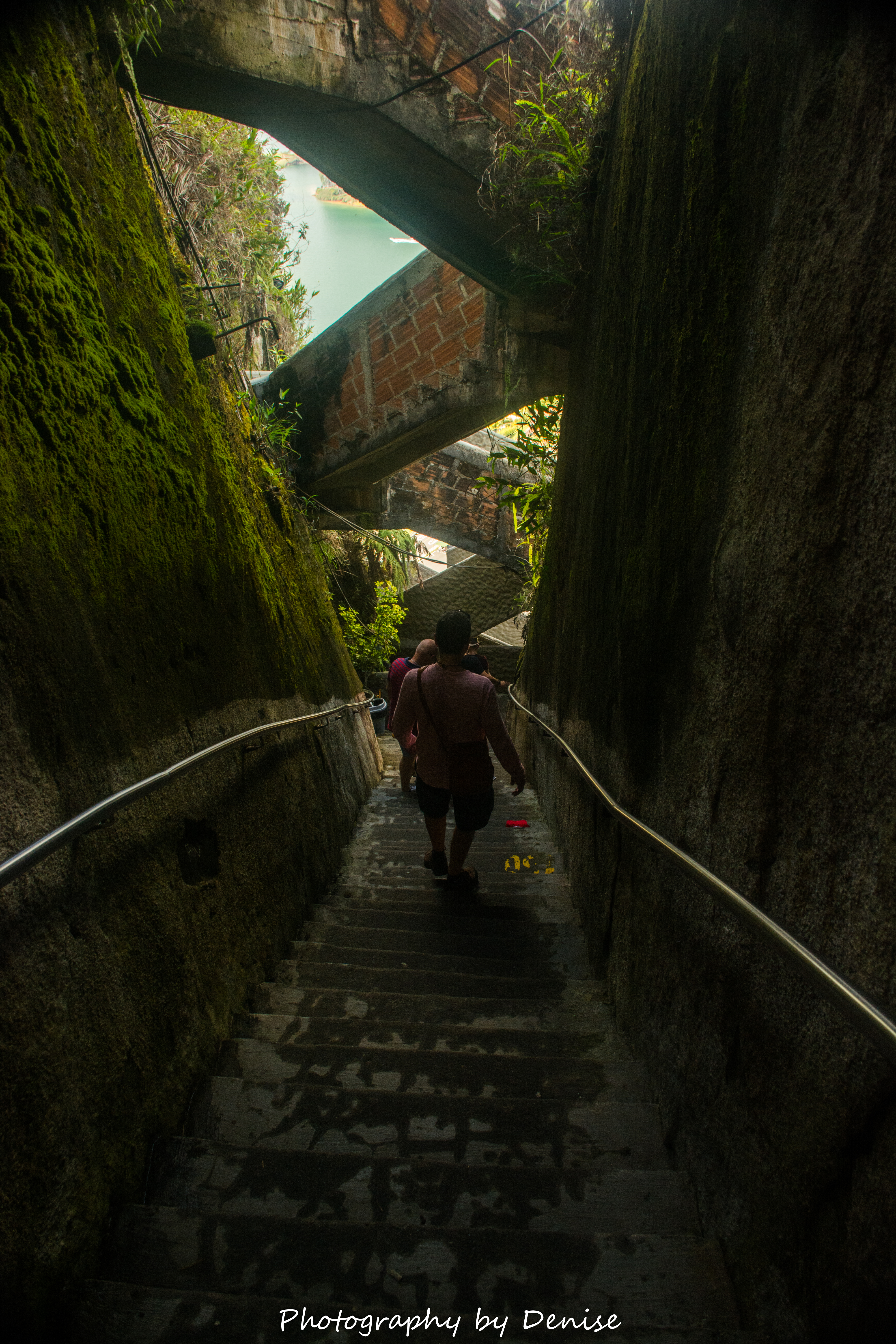
675 steps up to an altitude of 200m to witness what is claimed to be the best view in the world.  A panoramic vista as far as the horizon towering above the town of Guatapé Antioquia.  Fresh water lakes formed by a hydro electric dam interrupted by small islands, dotted with what you can only imagine to be vacation homes and the odd boat speeding from one island to the next.  You can almost see vacationers tanning on the decks with children splashing in the water enjoying the brilliant sun shiny day that it was.

It is known as “La Piedra” and has been the reason for many rivalries between the towns of El Peñol and Guatapé over the years.  This is highlighted by the letters “G” and an incomplete “U” (leaving the letters GI) painted on the western face of the rock.  The two towns had long disputed ownership of the rock and the residents of Guatapé decided to settle the matter by painting the town’s name on the rock in huge white letters.  It did not take long for the residents of El Peñol to notice the work and a large mob was assembled to stop it, leaving behind the unfinished graffiti.*

According to geologists the rock is approximately 65 million years old.  The indigenous Tahami, former inhabitants of this region, worshipped the rock and called it, in their language “Mojarra” or “Mubarak” (rock or stone).   The landform is a granitic rock remnant that has resisted weathering and erosion.

Climbing the rock is not for the faint hearted.  Yet it’s a challenge that many take on as the view literally takes your breath away.

* Wikipedia
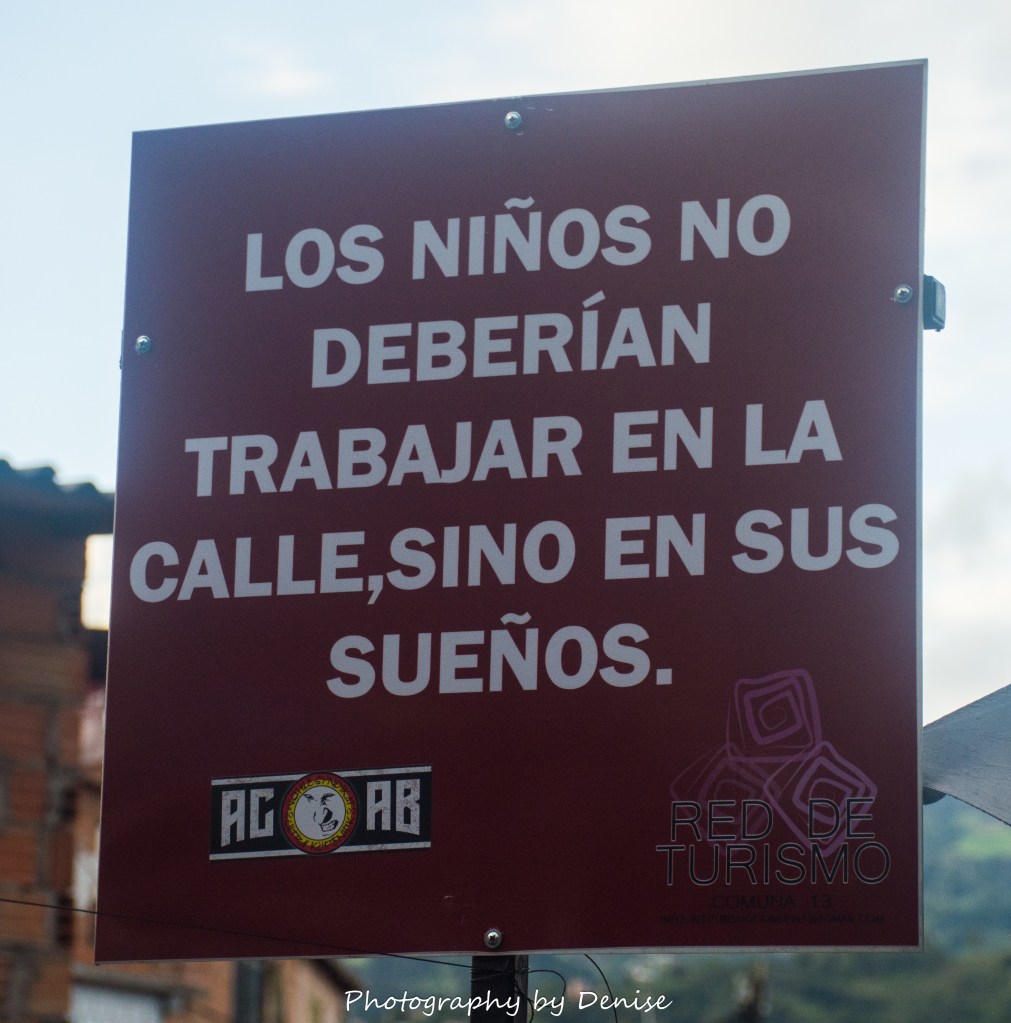
La Comuna 13

Children should not be working in the streets, but on their dreams.

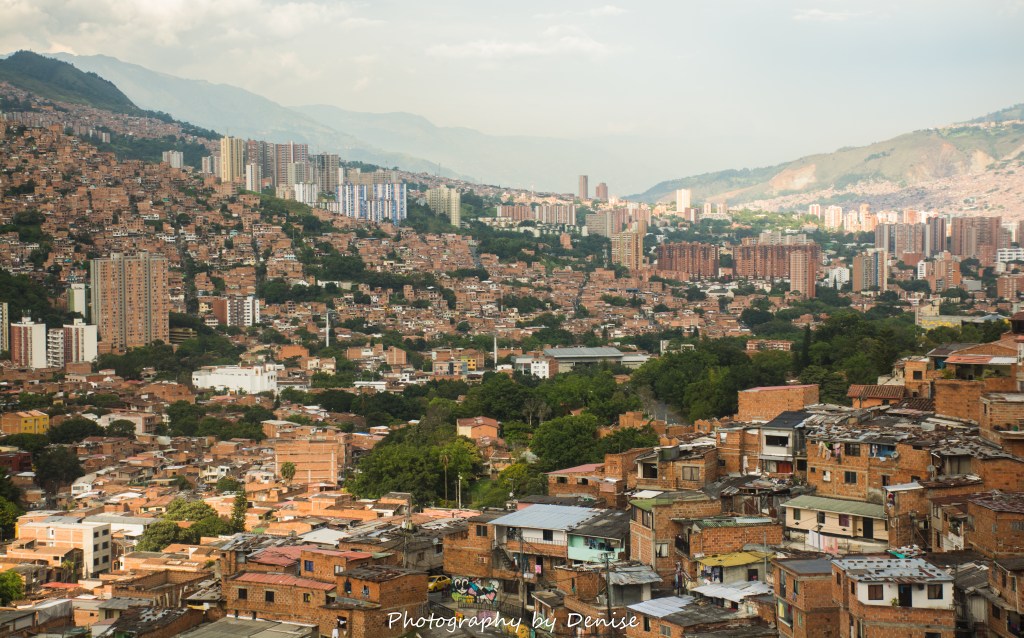
Comuna 13 was considered one of the most dangerous communities in Medellin if not the world.  Many may remember our fear of even so much as visiting Colombia due to the rampant drug trafficking and the violence that surrounded this trade.  Stories abounded with kidnappings, drug lords taking over small communities, the crime rate soaring.  After the death of Pablo Escobar in 1993 however, the government decided to intervene in the ongoing destruction of its youth in Comuna 13 one of the hardest hit communities where a life of violence and crime seemed to be the only option open to its residents to climb the social ladder, or so they were led to believe.

Investment was made in the infrastructure of the community allowing everyone access to schools and public transport instilling in them not only a new vision for their future but a sense of pride in themselves and their community that has transcended from generation to generation.  A community that truly embraces the spirit of ‘each one help one’.

Today Comuna 13 is considered one of the safest districts in the world, its walls covered in graffiti art depicting not only the struggles faced by their inhabitants and the evolution of its community, but also embodying messages of peace and unity amongst its people.  As you walk the streets, you are entertained by self made dancers, hip hop artists, singers – all intent on making an honest living while promoting a life of honesty and integrity.

We thought we were going to visit an exhibition of the finest street art Medellin has to offer.  Instead we were silenced by the beauty and humility of its people, the exuberance of a new culture of youth who look out for each other and who understand the value of community living.  We felt safe and secure exploring the ins and outs of the many shops and thoroughly enjoyed the talents of the local artists who performed on demand for our voluntary contributions.

You can visit on your own or with a tour guide (Aeroturex).  You will be welcomed with open arms at all times.

An overhead view of la Comuna 13, courtesy our Tour guide Aeroturex

No Dejes Rastro

These three little words follow you wherever you go in el Canon del Rio Claro situated west north west of Bogota, Colombia.  Its owner intent on ensuring that the natural environment is kept as pristine as possible.  But in its own way, this place unknowingly leaves traces of serenity and beauty in your heart and soul.

A mere 5 hour drive from Bogota, traversing the undulating terrain and beauty of the Central range of the Colombian Andes, el Canon del Rio Claro is tucked away in Antiquoia.  As you enter you are immediately transported to what can only be described as a place of peace and quiet.  As you drive alongside the rambling river of Rio Claro to the reception area, you are surrounded by natural forest and can see small waterfalls, and hear the chirping of birds along the way.

The buildings are tucked away in the forest and made of natural materials.  Your connection to the outside world is limited, there are few ‘new world’ amenities but you willingly forego what you consider to be ‘must haves’ in your modern world and embrace the simplicity of life as you truly have all you need to relax in these surroundings.

Our day was magical, exploring the Rio Claro from many different angles.  It began with a short but invigorating run along the river, the trail carrying you through stone paths, across wooden bridges, alongside huge rock formations and down onto small beaches beckoning you take a quick dip in the flowing waters of the Rio Claro.

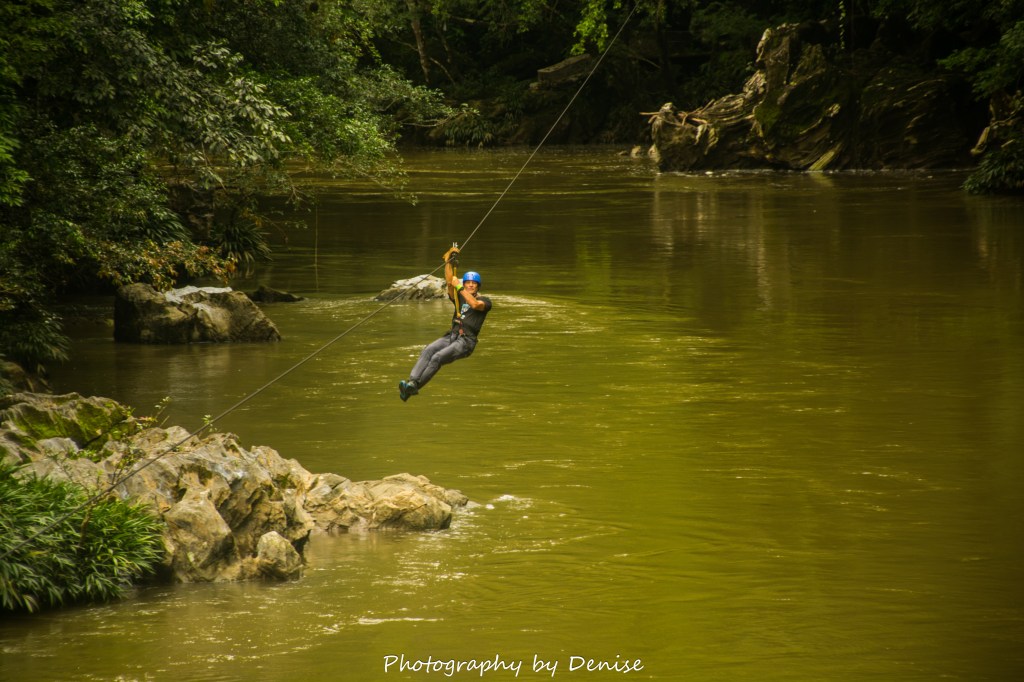
Then we literally zipped across the river through the canopy of the forest surrounding the river enjoying the expansive overhead view of the terrain wishing that we could do it again and again.  Ending with a quiet but exciting rafting on the river itself, jossling over the rapids, cruising under the waterfalls, and of course taking a quick swim in refreshing water.

This place is used as a weekend retreat for the locals, visited by many young Colombians who want to enjoy the daily activities as well as bird watchers from around the world who want to get a firsthand view of what the forest has to offer in a more intimate manner.

We did manage to leave some traces in Rio Claro, our worries and pieces of our heart.

Fall-ing in love with Nova Scotia …

Not having had the pleasure of living in North America, coupled with my hobby as an amateur photographer, I’ve been longing to witness the splendour that is Autumn – the ‘changing of the leaves’ as it is fondly called. Never in my wildest dreams, however, did I expect this to be one of my most gratifying bucket-list adventures.

A big thank you to family and friends who willingly took the time to show us (my husband and I) around the sites of Nova Scotia – from the coastal views to the highland mountains of Cape Breton. From hiking trails in Minas Bay – Bay of Fundy, where we ventured off the beaten path to hidden beaches and feasted on wild blackberries, to cycling in St. Margaret’s Bay through paths shrouded in Maple and Pine trees, covered in Autumn leaves. Stopping at my whim and fancy to capture what I can only describe as Mother Nature at her very best. I am eternally grateful to their generosity of heart and spirit, time and friendship and, of course, love of adventure.

I’ve been summoned to return in the summer to experience another facet of Mother Nature’s exquisite artwork, but I know deep down in my heart that she has shown me her best. It can never be the same – hmmm… or can it …

See for yourself…

Enjoying the beauty that is Cape Town…

Cape Town is one of the most beautiful cities I’ve ever visited. Like Sydney (which captured my heart a few years ago), its location on the coast affords the city amazing views, great opportunities for outdoor activities, and, as you can imagine breath-taking sunsets. Both night and day its seafront restaurants and commercial centre are bustling with activity, and at night the local budding artistes serenade you with sounds of African music, reminding you that you are indeed in South Africa. In stark contrast to Johannesburg, Cape Town isn’t typical of what you would imagine to be South Africa.

We explored the city and its surroundings in just three short days, revelling in the first instance in the scenic drive to Cape Point. Cape Point is in the Cape of Good Hope nature reserve within Table Mountain National Park. And as you drive along the western coast from Cape Town, you are greeted time and time again with beautiful valleys, bays and beaches. You find yourself stopping more frequently than planned just to gasp for a moment at the beauty of the rugged coastline and the flora and fauna that surrounds.

On the return drive up the eastern coast, the coastline and small, busy villages, tempted us to stop and relax at one of the seafront restaurants, to enjoy the local cuisine, with the sun setting at your back and the sound of the waves crashing against the shore line.

Up next – our visit to Table Mountain, possibly the world’s oldest mountain, which was voted one of the New 7 Wonders of Nature in 2011. Looking up at the mountain from the town below, you would never imagine the scope of walking and jogging trails, viewing points, wild flowers. Table Mountain is many things to many people. To Capetonians, in particular, it is the geological and spiritual heart of the city, and it’s easy to see why.

The vistas from atop are mind boggling and probably some of the most captured views in the world. We witnessed many a form and fashion of picture-taking. From selfies, to dare devil stunts at the edge of rocks, all trying to create the most exciting pose on what seemed like the top of the world.

And, my favourite part – the end of any given day in Cape Town. We drove to a vantage point on Signal Hill and sat quietly as we watched couples, friends, families arrive one by one, with their picnic baskets, to witness one of Cape Town’s most spectacular events – their daily sunset.

We were entertained by the para-gliders who carefully attached their victims and ran off the mountain sailing, peacefully to the beach below. Not more than a 10-minute flight, but one which provided a wonderful thrill for all who sat there waiting for the day to end in all its glory.

And glory it was. Wine glasses clinked, birthday cakes were cut, hugs and kisses exchanged, selfies galore – all in celebration of one of the most beautiful sunsets I’ve ever witnessed.

Yup. Cape Town. A beautiful city. Not to be missed.

Meeting Her Majesty…

And there she stood – elegant, poised, sensitive to my presence. Maybe a bit wary of my intentions. Nonetheless, she always maintained her composure and, turning away ever so gently, would walk slowly at first and then gallop away with her young ones to a more secluded spot where she could continue to enjoy the peaceful surroundings of this, her nature reserve.

Her majesty, the Giraffe. I encountered her several times while cycling through the Mkhaya and Mbuluzi nature reserves. Sometimes in the distance. Sometimes on our path. At all times, her majestic presence left me in awe of this wonderful creature.

I remember searching through the trails looking for her, taking little notice of the herds of nyalas and warthogs and pods of hippos. I gasped. She just stood there, as if to say “Me? Looking for me?” I smiled. And almost with a gentle bow, I replied, “Yes. I’m looking for you.”

She never disappointed. Was always gracious. And each time I stumbled upon her, I gasped silently. Always happy to see her. Always honoured to have made her acquaintance.

My game reserve experience…

Excited. Anxious. Cautious. Just a few of my emotions as we boarded the open truck and ventured through the wild tracks of my very first game reserve experience.

We will see hippos, rhinos, giraffes, wildebeests, lions, elephants, zebras – what’s your preference? – announced our guide. Well, all……

And as we ambled through the rocky terrain, the animals seemed to appear one by one, as if on queue. Some close by, others in the distance. Some lazing in their favourite waterhole, others scampering away as we approached. Few staring curiously, others not even phased by our existence.


At all times however, our guide taking us carefully through the reserve, stopping at certain vantage points, allowing us time to experience the closeness of these wild animals.

At times we understood that we were not very welcome. An uncanny feeling when you venture on foot towards a mother and baby rhino and discover that you are now surrounded by three large female rhinos whose instinct is to protect their young. So what do you do? Carefully, slowly retreat. Retreat. Retreat. And there and then you understand fully that you are not in charge. You understand the power of the ‘village raising the child’ and wonder when we humans lost this instinct to protect each other so fiercely. Or have we?

It was encouraging to see other families of giraffes, warthogs, nyalas, impalas – an indication that these reserves are indeed successful in keeping these species alive.

Cycling through the Nature Reserves…

Cycling through the stony trails of the Milwanee, Mikaya and Mbuluzi Nature Reserves, gives you not only an exhilarating work-out manoeuvring the undulating terrain, but a closer look at the wild animals living there. Hmmmm… I keep saying ‘wild’, but in essence these ‘wild’ animals exuded nothing but peace. They went about their business as if we were not there – for the most part anyway.

They allowed us to traverse their territory once we respected their space, respected their needs. And that’s fair enough. At no time did we feel threatened. Quite the opposite. We felt grateful that we could get a glimpse of their daily lifestyle. And to be honest, it seemed to be pretty much one of leisure. Grazing, laying in the shade, glancing at us only briefly just to acknowledge our existence, I imagine – then continuing on as if we were not there.

Before I left on this vacation, my eldest brother, out of concern for my safety of course, mentioned simply that I didn’t need to be the fastest cyclist, just not the slowest on the trail. At no time however did I feel threatened cycling through the vast open spaces, or sometimes scary single-track paths.

The journey was exhilarating and challenging to say the least. All the while though, giving me a great sense of accomplishment, peace and oneness with nature.

The future of Soweto

I wanted by all means to visit Soweto. Apart from the saga that was Apartheid, Soweto (South Western Township) was one of the few other identifiable historical aspects that piqued my interest when we decided to visit South Africa.

What I learned during our visit to the Apartheid Museum and the Nelson Mandela Museum, prior to driving through Soweto, prepared me only slightly for the emotions that would haunt me in the days to follow. The images of wealth vs poverty, and the sheer delight, wonder and innocence in the eyes of the children, continue to flash across my mind.

Soweto in itself is a world full of opposites and surprises – where different classes survive as neighbours with the rich neighbourhood seamlessly transitioning to the middle class neighbourhood. Yet the high level of poorer inhabitants dispels your hope for a better Soweto. A world where you smile at the progress and at the same time are saddened by the fact that not all persons have benefitted from the efforts at rehabilitation.

A world where you can only imagine the inhabitants to be depressed and hopeless at the apparent lack of support from the outside world to ensure their bright future. Yet the people are full of pride. They are a people with a vision. They are gracious, grateful, warm and hopeful. They are a people whose positivity you hold onto as this can only augur well for the fulfilment of their own bright future.

And yet, I left with a heavy heart, even more aware of the inequality that surrounds us, but with a strong admiration for the strength and perseverance of the Sowetans.

Africa – the birthplace of humankind

The Cradle of Humankind World Heritage Site is an area of outstanding universal value. Its complex of fossil-bearing caves contains an amazing record of the stages in the evolution of humankind over the past 4-million years. It is rich in research – its visual and engaging exhibitions expose you to the world’s most prolific displays of our lineage.

It puts perspective on your ancestry. You wonder no more where you came from, how you evolved, the why’s regarding the physical differences from one part of the world to another. It makes you ashamed of the way we ostracise and treat one another with very little regard.

It also leaves you questioning the modern human’s contribution to the future of the world and to its own preservation. And, quite naturally, you ask yourself – ‘When will we stop, think and consciously make a positive impact on the world in which we live, a world which we will commit to preserving for many generations to come. For it seems that the more we explore and create, the more we destroy.

Pics taken in and around the cradle of Humankind